
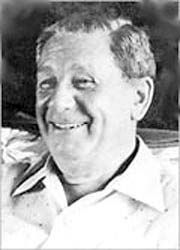
 Many of us enjoy the classes in which Joel answers questions from students. Sometimes the question is one that we ourselves might have asked. Other times it is one that might not have occurred to us, but which we find interesting, and we are curious about how Joel will answer it.
On this page of our website, on the first and third Saturdays of the month, we will post a new question and answer from one of Joel’s classes or books. We trust that you will find these interesting, helpful, and sometimes an answer to just what is on your mind.
You can also view, download, or print THIS question and answer by clicking/tapping here and then clicking on the download icon at the bottom of that page.
Posted on 10/17/26
This copyrighted excerpt is from Recording 399A: 1961 Los Angeles Class, titled “The Function of Mind.” It is posted with the kind permission of the Estate of Joel Goldsmith, which holds the copy protection for the recorded classes and the copyright for the transcripts. The full transcript of this recording is available from The Infinite Way Office or by calling 1-800-922-3195.
Goldsmith Global has permission to provide this material to Goldsmith Global participants for educational and study purposes. Please respect the copyright on this material.
If you have access to recording 0399A and would like to hear Joel answer this question, he begins at approximately 25:59. If you have a streaming service subscription, you can go directly to this question and answer by clicking/tapping here. The recording will already be queued; simply tap the play button.
Q: When we attain pure Spirit, will we have a mind?
A: I don’t know, I don’t know. And all of these [questions] have to do with the subject of mind and the confusion that has arisen out of the statement that mind is not God; thought is not power. Try to follow this with me.
It is an impossibility to make a statement that God is this, or God is not this, because God, being infinite, is beyond any capacity to define, analyze, or explain. Anyone who would attempt to explain what God is has just gone far beyond anyone who has ever lived. And they’re going to introduce probably a new era because it is not possible.
It is possible to experience God. As a matter of fact, that is the goal of all of our work. It is possible to know God aright; it is possible to be consciously one with God so that there is no place where God leaves off, and we begin. But it is not possible to analyze, dissect, or describe God.
With mind, that is something different. We know all about mind. Mind is an instrument of awareness. Through mind we know; we become aware; with mind we reason; we think. Therefore, mind must be an instrument, or an effect. It cannot be a cause. Mind cannot cause anything. And the reason is I am behind the mind. When I say “I,” I’m speaking now of “you.” I am behind the mind. I can think through the mind and with the mind. I can reason with the mind and through the mind. I can use the mind. And therefore, I am greater than the mind.
And you want to know something? That even as a human being, I am greater than the mind because a human being can control his mind if he sets out to, wants to, is willing to study and practice. A human being can use his mind for a reasoning purpose, a thinking purpose, a contemplating purpose. Therefore, even a human being is greater than his mind.
Now then, when we come to this next point, it settles once and for all the fact that mind can never be God. Mind can be the instrument of either good or of evil. You can think good thoughts with your mind or bad thoughts. You can perpetrate good deeds or bad deeds through the instrumentality of your mind. Mind can be the awareness of something good or something evil.
Now try to imagine God in that light, and you’ll see how utterly fantastic it must be to think of God as mind. If mind is the creator of thoughts, and we can have good thoughts and evil thoughts, then God is certainly not mind. “God is too pure to behold iniquity … God is light and in Him is no darkness at all.” In other words, when you penetrate beyond mind, you are in the realm of neither good nor evil; you are in the realm of pure being.
Naturally, if you are thinking from a theological standpoint, it doesn’t shock you to think of God doing good and doing evil. You have perhaps heard enough funeral services, in which “God takes our beloved ones home” through horrible diseases and pains and accidents and alcoholism and all the rest of it. And, to the orthodox mind, that doesn’t seem a bit shocking. But if you have progressed at all, you certainly must have a higher idea and ideal of God than as some superhuman, capable of good and of evil.
Now, whether or not it appeals to the reason, I wouldn’t know. But I do know this: that if you receive illumination of any kind or degree, if you feel an intuitive sense within you, you will soon have it revealed within your own being that God is good—not good and evil—good. God is love—not love and hate, just love. God is life—not life and death, just life.
Therefore, God is one, and there is no duality in God. There are no pairs of opposites in God. And while that has been unique in the Western world, in the message of The Infinite Way, it is not at all original except that it was revealed to me originally, but not exclusively. For in the ancient teachings of the Orient, once you attain samadhi, or go beyond the pairs of opposites, you attain the consciousness of neither good nor evil. You are in a state of consciousness in which you cannot do good or evil; you can just be, just as the sun cannot do good or evil; it can just shine.
If you are out in the sun, and it benefits you, you say it’s good, but if you’re out a little too long and get burnt up, you say it’s bad. And the question is, “Well, which is it—the sun—good or bad?” And the sun can’t be good or bad; it can just be the sun. So it is when you go beyond the physical expression of life into the Spirit, you will know that the Spirit is life eternal, and therefore, there are no pairs of opposites in the Spirit. Now, as you get into our healing work in The Infinite Way, and you reach that place where our practitioners have to work without thoughts, without argument, you will see this proven to you conclusively.
Let me, for a moment, go back to the early days, the very early days of Christian Science, and point out to you that Mrs. Eddy, through the power of mind healing, produced wonderful healings, and taught students how to do this. Those who have any knowledge of Mrs. Eddy at all know that her work was purely in the light of beneficial work, helpful healing work, that her whole motive in life was that of good. Never did she dream that this power she was using for healing could be used for evil until, in many different ways, it was brought to her attention that some of her students were reversing her teaching and producing evil. They could even take healthy people and make them sick; they could take pure people and make them immoral. And they very quickly learned how to take people’s money away from them to such an extent that Mrs. Eddy wrote this sentence: “The day will come when the thief will not have to enter your house; you will bring your possessions to him.”
And a few years ago, that prophecy came true, when moving picture programs were put on the air to make you bring your dollars down to the Coca-Cola counter or the popcorn counter. Whether or not you wanted it, whether or not you wanted to give up your money, you had no power. They controlled your mind and made you give up your money. They could have gone on, had it not been stopped. They could have gone much further, but they were stopped.
Now, all of this and many things that I won’t even mention here give us abundant proof that the mind can be used for good or evil—it can be used to bless, and it can be used to curse. A minister wrote a book a couple of years ago proving that with his mind, he could make plants grow, and he could kill plants with his mind. He even taught some of his students to work with their minds to make plants grow, and other students how to kill the plant with their mind. Do you believe that mind is God? No.
Therefore, let us understand this: mind is an instrument. And, if you transcend thought, in other words, if you reach the consciousness in which you can sit and hold an attitude of listening so that you have the unconditioned mind, you’re doing neither good nor evil; you’re just letting it be an instrument for the Spirit; you will find that your mind will be the instrument for revealing harmony. Where disease was, there will be health; where the fear of death was, there’ll be life; where the possibility of accident has been, there will be harmony, safety, security. In other words, the closer you get to the ability to meditate, that is, to sit in a state of receptivity with no conscious thinking taking place, you will be at the place where you do neither good nor evil, but you are an instrument through which harmony is revealed; harmony is revealed even where discord had been.
Now, remember that while you are functioning on the plane of thought, you can use your thoughts to heal and to bless; you can send out good thoughts. But please remember that there are those who can use their mind for evil if they so wish, because the mind can be used either way.
Now then, why do we say, “God is the mind of individual man?” And we mean this: mind in its unconditioned state, pure mind, is the instrument through which we attain God-awareness. In other words, we do not function without a mind, but unconditioned mind—mind freed of personal human thoughts—becomes a clear instrument through which Spirit is made evident to us.
Whether or not in some state of pure Spirit we will do without mind, I do not know. But I do know this: that in our present state of being, mind is a very important function of our being, and the purer we can keep our mind, the greater degree of harmony we will bring into our experience. In other words, “Thou wilt keep him in perfect peace whose mind is stayed on Thee.” Now you see, there’s a choice there. You can keep your mind stayed on obscenity, vulgarity, destructiveness. But “Thou wilt keep him in perfect peace” whose mind is not stayed on those, but “is stayed on Thee.”
How do we prove that in our experience? Let me tell you. This is one of the most wonderful parts of the entire Infinite Way experience. A mind imbued with truth is a law of harmony to you, to anyone within range of your thought. A mind, your mind, imbued with truth is a law of annihilation to discord and inharmony. Choose ye! If you wake up in the morning, and you live your ordinary human life—I mean, [your life] before you came to the spiritual work. Get up in the morning, jump out of bed, have a shower, have your breakfast, rush out to business or market or shop or art or whatever you’re doing, go, have your breakfast, have your lunch, have your dinner, come home at night. After all your entertainment, retire. And all of this time, your mind is devoid of spiritual truth. I can tell you what your life will be: just pick up the newspaper, and you will see. Read novels; you’ll see what human life is when the mind is devoid of spiritual truth. You are living in a dual universe. Good can happen to you today and bad tomorrow. Wealth can happen to you today and lack next year. You could be poverty-stricken this year and wealthy next year. Anything can happen; nobody has any control over it; it’s hit or miss; it’s luck, chance, accident, cleverness, or whatnot.
Watch the lives of the Christian Scientists, the Unity students, the New Thought students, who awaken in the morning and turn to the Spirit, turn to God, whatever their concept of God may be; who either do a daily lesson or read a magazine—fill their thoughts with spiritual truth. Watch these students of The Infinite Way, who have learned how to awaken in the morning and remain in bed a few moments to absolutely bring to conscious awareness the presence of God. And then, throughout the day, to follow a program of keeping the mind stayed on God, “acknowledging Him in all thy ways.” All—from waking up in the morning to retiring at night, and even when waking up in the middle of the night, to not try to get back to sleep, not take sleeping pills to get drugged, stay awake and meditate, and become renewed even in the middle of the night, not by sleeping, but by communion with the Spirit.
Then you will find this: that as your consciousness, your mind, is imbued with truth, with spiritual truth; as you make God a part of your day and your night experience, gradually these erroneous experiences of human life begin to disappear. And the first thing you know, well, you’ll come up against something like this—I’ve had this happen—students come and say, “You know, I just don’t see after all these years in truth, I don’t see what the benefits are, I don’t see that I’m so much better off.” Then I say, “How many days, weeks, or months have you lost from your work through sickness? How many dollars have you spent for doctors and medicine and hospitalization? How much of sin and disease has come into your home?”
“Oh! Oh, oh, oh! I hadn’t thought about that.”
No. You see, we’re looking for some kind of flashy demonstration, some kind of miracle out of the sky. But spiritual living isn’t that way; spiritual living is a dying daily to the fleshly sense. It’s a sloughing off, a falling away of materiality and physicality, and a gradual coming into spiritual awareness, harmony in the outer plane. I am sure that any student on the spiritual path, metaphysical path, who’s been on it three years only must be able to look back and see some change in their consciousness, some change for the better, and probably some change in their outer experience that they really haven’t been aware of until they searched. It’s there; it can’t help being. The mind that is imbued with truth, that maintains truth in consciousness, must eventually find that the new consciousness is being formed, and when the new consciousness is formed, the new body is formed.
So it is then, your mind is an instrument for your use. Ah, I might say this: Just exactly as your body is an instrument for your use, so is your mind. You can use your body in your human sense; you can use it for good or evil; you can use your hands to hit, to punch, to kill, or to be benevolent and loving. The body is an instrument. How are you going to use it?
The mind is an instrument. You can use it any way you want up to a certain point. Once you’ve touched a spiritual path at a certain point, you no longer have the capacity to think evil, to do evil, to desire evil. And because of that, you experience very little of it, and the little that you do, there is a way of meeting. Your mind, therefore, like your body, is an instrument.
It may be that those who have not yet been led to any of the metaphysical approaches have no control over their minds and therefore cannot decide what they will read or what they won’t, or what they will think or what they won’t. They have no choice. That is unfortunate. Probably that is why the Master said, “The poor we always have with us”—the poor in spirit, those who have no capacity, no knowledge of the spiritual side of life, and therefore live out their whole lives, you might say, in the gutter.
But there isn’t any one of these major metaphysical and spiritual teachings that I have mentioned where, if you wish, if you follow the teachings of the original leader—follow Mrs. Eddy’s actual teachings, or the Fillmores, or Ernest Holmes, or Dr. Bailes—follow any one of those like our teachings, and you will find that it will not be long until you will be on the right side of spiritual living because your mind will be imbued with truth.
Your mind, then, is the instrument, and filling it with truth, you bring forth harmony. Devoid of truth, you bring forth a little good and a little evil, or a lot of good and a lot of evil. When we then use mind with a capital M, and say, “the Mind of man is God,” let us understand really that we mean Mind with a capital M, the unconditioned Mind, is the instrument of God, the way whereby God is made manifest unto us.
Because as you follow The Infinite Way, you will come to another stage that is not found in the other approaches. You will come to where you do not use your mind at all—not for good and not for evil. Your mind becomes an instrument for God. And you do not use it; you place it at the disposal of God. In other words, you surrender it, and you do not think good, and you do not think evil. You do not plan good, and you do not plan evil, but you hold yourself perhaps like a composer who’s listening and then, all of a sudden, catches melodies. He catches that from the cosmic. But as you are holding yourself unto spiritual truth, truth floods in, and that truth manifests itself on the human plane in the ideas necessary for our experience. And those ideas are good and not capable of being used for evil.
Our whole work is appointed toward attaining that mind that was in Christ Jesus. That is not a thinking mind, not a reasoning mind, although in our ordinary everyday human things we think and reason. But the main function of our mind is an avenue of awareness, an instrument whereby we become aware of the presence of God. We call that the transcendental mind because it is the unconditioned mind.
Now, we don’t have a mortal mind, a human mind, and a spiritual mind; we only have a mind. There is only one mind; that’s all we have. And if we keep it in its unconditioned state, we become subject unto the Spirit. If we use it in ordinary ways, we may use it for good or for evil, and if we become metaphysical, we’ll use it entirely for purposes of good. But as you go the next step beyond, you reach that place where your intent isn’t to do good or to do evil. Your intent is only that God may use the mind as an instrument for Its expression.
Now, that brings us to a very important point: “I do not know how to pray, I do not know how to go out or how to come in, I do not know what to pray for.” So says Scripture. That is the ultimate accomplishment in our work—where our prayer has in it no element of desire, no trace of any wish. Our prayer is only an opening of the soul, to the soul, within the soul, that the will of God may be made manifest. That will of God may not always be what we have in mind. But you can be sure of this: the will of God is always good. There is no such thing as any untoward experience coming to us through a total surrender to God. Why? God is incapable of evil. God is incapable of error; God is incapable of accident; God is incapable of sin. In Him is no darkness.
Therefore, when we sit in meditation, or prayer, or treatment, and assuming you have asked me for help and, as I’ve said to you, your name means nothing to me, your identity means nothing, the particular claim means nothing. The fact that you have contacted me has established a spiritual bond between us. And now, when I attain the conscious realization of God, you receive the fruitage, the benefit. So that you have asked for help, and I sit here with this ear open—not that it makes any difference whether it’s this one, or this one, or both. But the ear is open in a listening attitude, and I might even say, “Speak, Lord, Thy servant heareth,” and if I don’t say it or think it, at least that’s my attitude, “Speak, Lord.”
When God utters His voice, the earth melteth. Therefore, all I have to do is be still, have no desire, no wish, no hope, no thought, no plan. Just be still until God utters His voice, until the still small voice announces itself, until a feeling of divine Presence is there, and then you feel the result. I do too, in a different way than you do, because I never know in what way the Spirit is benefiting you. You may want to be healed of a disease and find that you aren’t; that it has changed some trait of character; that it has changed some part of your nature. If it has, be assured of this: the disease is on its way out.
In other words, very often, before a physical condition will yield, some trait—mental trait or moral trait—has to yield, and then the outer yields. In most cases, this is not true for this reason: most of the ills that afflict us have nothing to do with ourselves, have nothing to do with our state of thought, or our state of morals, or our state of anything else. They are merely universal beliefs that we have picked up in mind, and the very moment someone comes along and realizes that mind isn’t power; thoughts are not power, the healing takes place.
But then there are things that go wrong with us mentally, physically, morally, and financially, that actually are produced by our own measure of erroneous traits in one way or another. And here the healing first must take place in this inner self, this inner awareness, this inner trait, character, so forth. And then that releases the physical.